Sudoku: The Compositor
Sudoku graded by the technique it takes. Not one grid here needs a guess.
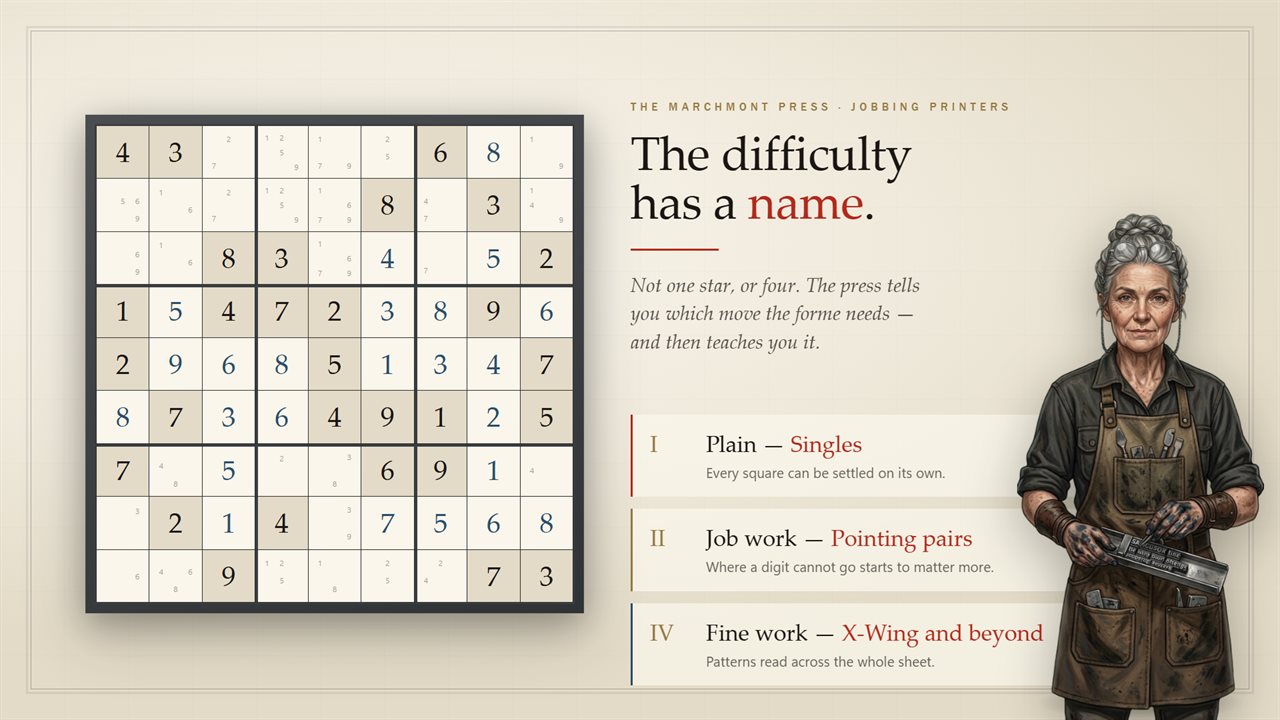
The difficulty has a name: singles, pointing pairs, pairs and triples, X-Wing.
See it in action
About Sudoku: The Compositor
Sudoku you can finish by thinking.
Fill the grid with 1 to 9, no digit twice in any row, column or box. That is the whole of the rule. What varies is how hard the reasoning gets — and here that is stated outright instead of hidden behind three stars.
Difficulty with a name
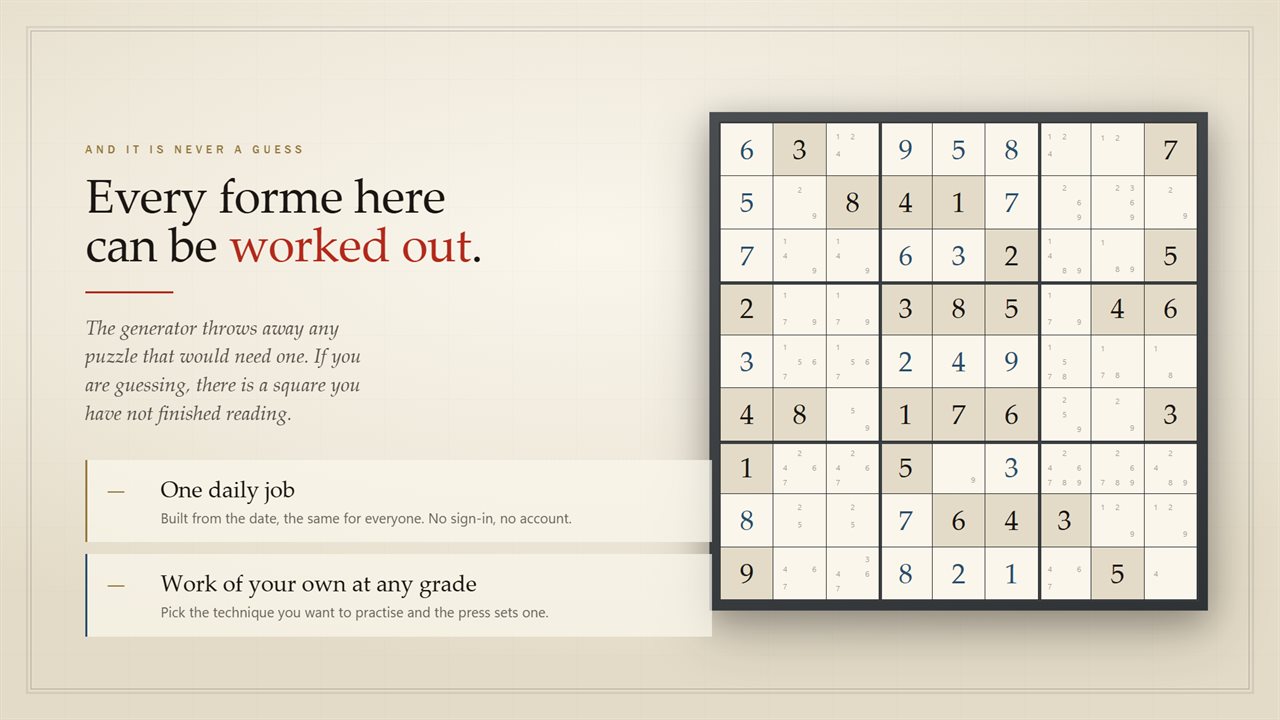
Every grid is carved and then solved by a solver, one step at a time, and thrown out unless it can be finished by logic alone. The hardest step the solver needed is what the grid is graded by, so a Plain job needs singles and a Fine job genuinely needs an X-Wing. There is never a point where the only move left is a guess — not in the apprenticeship, not in work of your own, not in the daily.
The four grades are Plain (singles), Job work (pointing pairs), Book work (pairs and triples) and Fine work (X-Wing and beyond).
The compositor
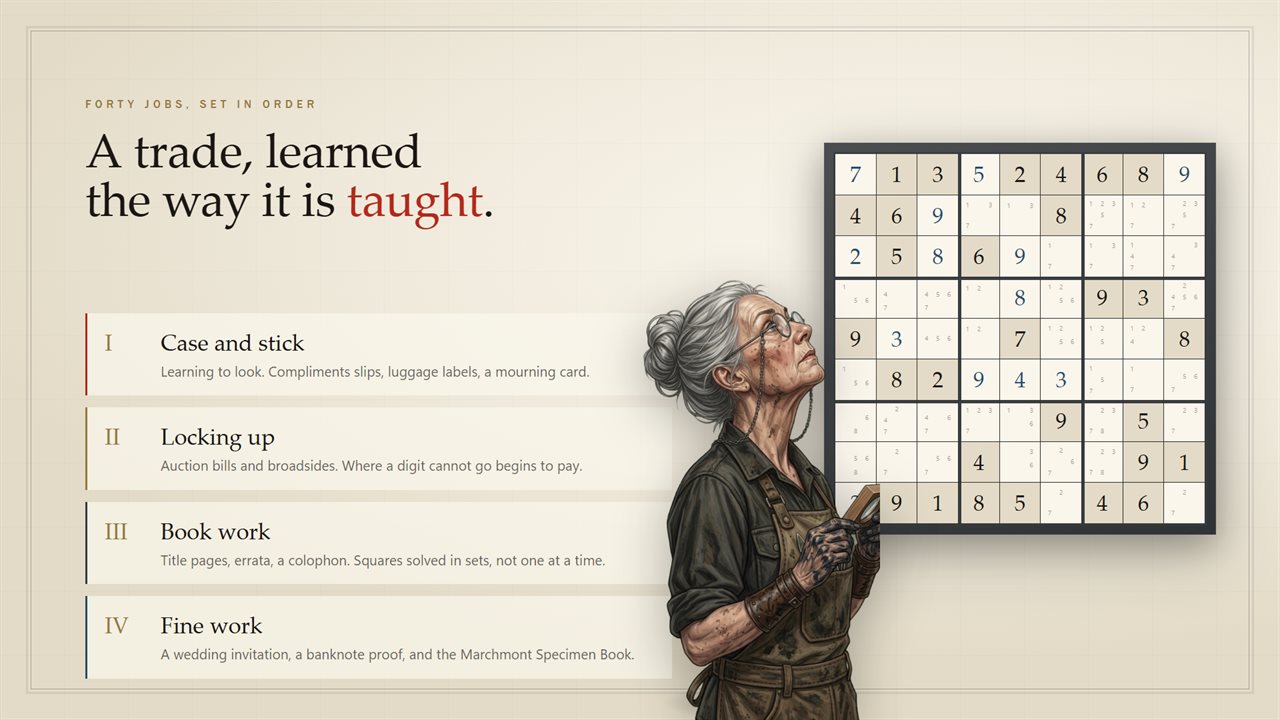
You are the new apprentice at the Marchmont Press, and Hollis Crane runs it. Forty jobs to set, in order, through four chapters: the compliments slips and handbills you learn to look on, the auction bills where what a digit cannot do starts to matter, the book work where squares are solved in sets rather than one at a time, and the fine work that ends with the Marchmont Specimen Book.
Hollis teaches all eleven techniques the press uses — full house, naked and hidden singles, pointing pairs, box/line, naked and hidden pairs, naked triples, X-Wing, XY-Wing and swordfish — but only when a grid first needs one, and in plain English rather than jargon. Learn a move once and she does not explain it again.
A hint that teaches
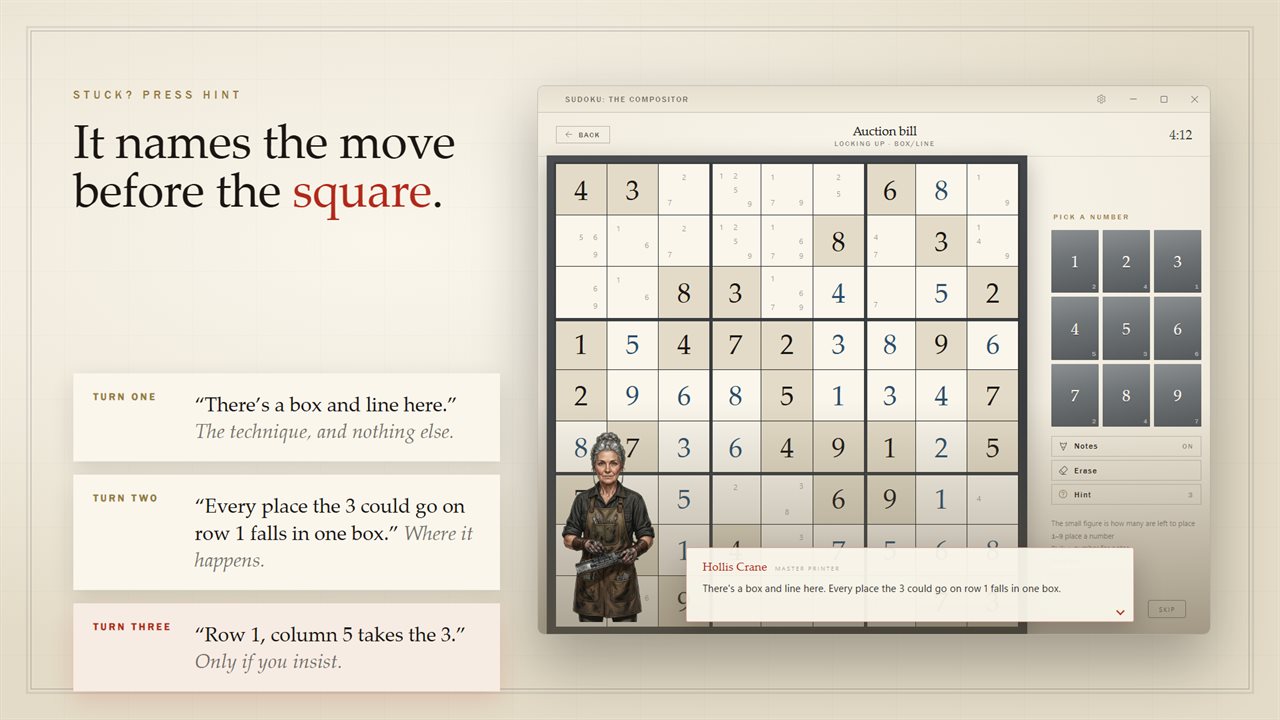
Most hints hand you a digit. This one takes three turns. First it names the move that is available. Then it explains why it works, on this grid, in this row. Only then does it point at the square and select it for you. Stop after the first turn and you have learned something; press on and you get the answer.
Your own work and the daily
Four grades, with a new grid carved and proved every time you sit down, and a best time kept for each.
The daily job is set from the date, so the grid you get is the grid everybody gets — easiest on a Monday, Fine work on a Sunday. No server, no sign-in, no leaderboard to farm. Just today's job, your time, and a streak the game keeps for you.
Built to sit with
Type a digit, or pick one from the case beside the grid and watch it count down as each is placed. Pencil marks with Shift, filled in for you if you want them. It tells you when a digit is wrong rather than letting an hour go to one bad square. Undo, a clock you can stop, and your place kept when you quit in the middle of anything.
Sound is made as the game runs rather than played from files — nine sorts to nine notes, so a row filling in is heard as a run — and it has its own switch.
It keeps everything on your own machine, plays entirely offline, and has no ads, no account and nothing to buy.
Built for Windows 11, and at home on Windows 10.
Features
- Difficulty is a named technique, not a star rating: Singles, Pointing pairs, Pairs and triples, X-Wing and beyond
- No grid ever needs a guess — a solver finishes every one by logic before you see it
- A hint in three turns: it names the move, then explains it, then points at the square
- Forty jobs in four chapters, each set at the grade that chapter teaches
- Hollis Crane teaches all eleven techniques in plain words, as the grids first need them
- Work of your own at four grades, with a new grid carved and proved every time
- A daily job set from the date — the same one for everybody, easiest Monday, hardest Sunday, no server involved
- Your place is kept: quit halfway through a Fine work grid and it is waiting where you left it
- Pencil marks, a number pad for the mouse, and the whole game on the keyboard if you prefer
- Best times for every grade, and a streak the game keeps for the daily
- Bought once. No ads, no account, no in-app purchases, and it never opens a socket
Details
- Works on
- Windows 10 (1809 or later) and Windows 11
- Download
- About 6.0 MB
- Version
- 1.1.4, updated October 2026
- First released
- August 2026
- Price
- $2.99 once. No subscription.
- Category
- Puzzle & trivia
Questions
Anything else? Ask us
Which versions of Windows does it run on?
Windows 10 (version 1809 or later) and Windows 11.
Is it a subscription?
No. Sudoku: The Compositor is a one-time purchase of $2.99, and updates are included.
How do I get it?
EvlarSoft apps are moving to direct downloads from this site. Ask to be notified and we will email you as soon as Sudoku: The Compositor is ready to download.


